
BUYING GUIDE
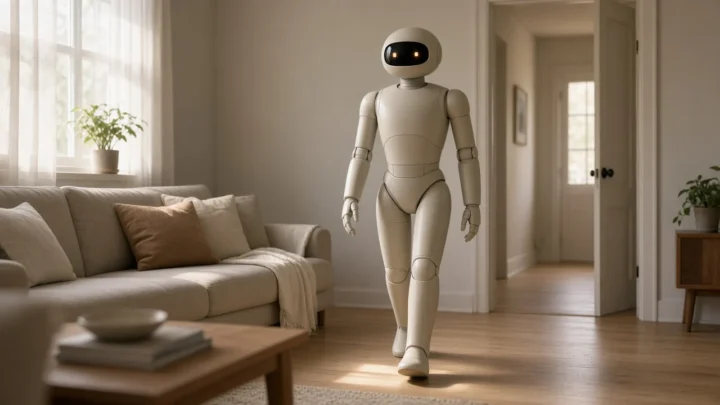
Apartment humanoid in 2026: what actually fits
An apartment humanoid in 2026 has to fit the doorway, the turn, and a dock that does not block the exit. This guide is that fit test — not a vacuum roundup, and not a factory robot with a small-home label.
Read the full guide →More guides
 SETUP
Introducing a humanoid robot to your pets and kids: a 2026 first-week guide
The first week a humanoid robot moves into a home where there are pets and young children determines what the following year will be like. If handled well, most of the household pets and children get used to the presence of the robot within a few days; if handled poorly, you could create a pattern of anxiety that will be very hard to reverse.
Read more → SKILLS
Laundry mastery: what humanoid robots can actually do with laundry in 2026
Laundry stands as the most widely promoted example of humanoid robots, yet it remains the most inconsistent in actual household settings. In 2026, consumer-oriented systems can indeed pick up clothes, sort them, and perform basic folding, but fully autonomous, end-to-end laundry is still beyond the capability of existing robots.
Read more → SAFETY
Kid and pet safety with humanoid robots: a practical 2026 owner’s guide
While 2026’s consumer humanoid robots incorporate multiple safeguards against home-related injuries, they certainly don’t pose zero risk. Owners with children and pets should be informed and careful, leveraging the manufacturer’s safety features, configuring the robot sensibly, and keeping an eye on it carefully, rather than being negligent about risk or opting out altogether.
Read more → BUYING GUIDE
Humanoid robot resale value report 2026: what your robot will actually be worth
In 2026, there won’t be anything like a secondary market in humanoids for consumers. The first private deals have been struck, but the markets that do exist are illiquid, with pricing very volatile and the software and warranty restrictions of some platforms and account requirements that make these things harder to resell than phones or cars. Plan to have a worst-case value close to zero.
Read more → SAFETY
How to run a privacy audit on your humanoid robot in 2026
The next-generation humanoid consumer robot is basically a mobile video camera, microphone and cloud-connected artificial intelligence that travels around your house for much of the day. And yet, most consumer robot owners aren't aware what kind of data these devices collect in the first place or what they do with that information, which means a 30-minute privacy audit upon delivery or whenever the robot gets significant software upgrades is perhaps the cheapest and most valuable thing you'll ever buy.
Read more → SAFETY
Joint maintenance for humanoid robots: what owners should actually do in 2026
Think of a robot’s joints as the engine for a car; just as with engines in a vehicle they require maintenance and upkeep. In 2026 most robotic joint servicing is light and easy enough to do yourself, though the heavy-duty parts should be left to factory-trained techs.
Read more → INSURANCE
Humanoid robot insurance in 2026: what you actually need
Covering a humanoid robot in 2026 is still an open question. The majority of existing home contents insurers will categorize it as a high-end consumer electronic product; this could result in limitations or even exclusions that you don't expect. Optimal coverage almost always involves a combination of a contents schedule for your home contents, a service plan provided by the manufacturer, and potentially even a specific humanoid robot policy for more expensive robots.
Read more → BUYING GUIDE
Humanoid robot financing in 2026: buy, loan, or subscribe
In 2026, a consumer humanoid at a published price is about $20,000, or roughly $32,300 over five years ($538 a month) once service and a spare battery are included. A subscription is a rental with its own quote. How long you will keep the robot matters more than the sticker.
Read more → SAFETY
The humanoid robot error code wiki: how to read and respond to errors in 2026
In 2026, all consumer humanoid robots will use a structured code system to record errors and warnings. Owners who know how to read the codes will be able to solve minor problems, know when help from the manufacturers is needed, and maintain a log of the robot's history to facilitate any claim for repair, refund or insurance at a later date.
Read more → SETUP
Home mapping guide: how to set up your humanoid robot’s spatial map for daily use
Every consumer humanoid robot launched in 2026 will begin by mapping your home. The initial home map will set the standard for navigation performance, task success rate, and how seamlessly that robot will be integrated in your household through the next year; you should take care to get the first map right.
Read more → SKILLS
Gardening with humanoids: what consumer robots can really do in the yard in 2026
Outdoors represents some of the trickier environments for a humanoid consumer robot. Rough ground, weather, dirt, and loose plant matter are some of the things that will challenge a humanoid’s capabilities. Carefully used, a humanoid robot can still accomplish some limited useful gardening tasks, but it can’t do as much in this space as it can inside a home.
Read more → BUYING GUIDE
Robots for elderly care in 2026: what a humanoid can and cannot do for an aging parent
Helping an older adult at home is one of the most over-hyped humanoid use cases in 2026 and one of the most genuinely promising, and the gap between those is almost entirely about scope. This guide covers what a humanoid can and cannot do for an aging parent, which robots are worth considering, what five years actually costs, and how to set one up so it is still being used in month six.
Read more →